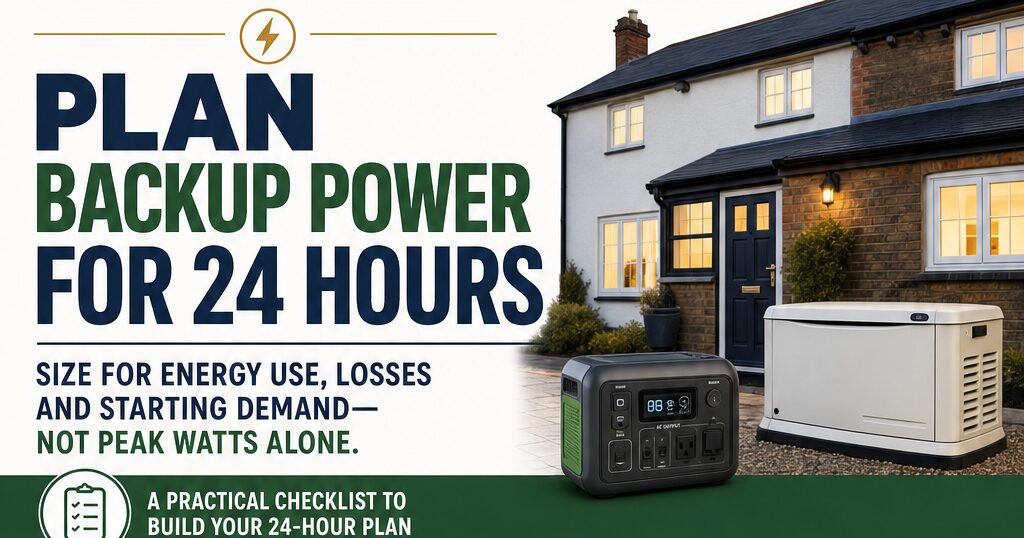

A 24-hour power cut is not simply a short outage estimate with one extra appliance added. If a battery system has to run for twice as long, its energy requirement roughly doubles too—and the result can be much larger if you try to keep every household load running.
So, how much backup power do you need for a 24-hour power cut? The answer depends on the appliances you need, how long each one runs, their starting demand and how much of the battery’s stated capacity is genuinely usable. A sensible plan starts with energy use in watt-hours, rather than choosing a generator or battery from its peak wattage alone.
Start with the loads that matter
List the equipment you want to operate during the outage and divide it into three groups:
- Essential continuous loads: items such as a broadband router, security equipment or a circulation pump that may need to run for much of the day.
- Essential intermittent loads: a fridge, freezer, lighting or a heating control system that cycles or is used only at certain times.
- Convenience loads: televisions, games consoles, kettles, microwaves, washing machines and other items you could leave off.
Check the appliance data plate, plug label or manufacturer’s specification for its rated input in watts (W). That is power: the rate at which it uses electricity at a given moment. Energy is measured in watt-hours (Wh) or kilowatt-hours (kWh), and is what determines how long a battery can support the load.
A device rated at 100W running continuously for 24 hours would use 2,400Wh, or 2.4kWh, before allowing for conversion losses. An appliance rated at 100W but used for only two hours would use 200Wh. Those are very different demands even though the power rating is the same.
Calculate a 24-hour energy budget
For each appliance, use:
Energy required (Wh) = power (W) × running time (hours)
For cycling appliances, such as a fridge or freezer, a nameplate rating may describe running input rather than its average consumption across a full day. If the manufacturer provides daily energy consumption, that can be more useful. Otherwise, treat any estimate as provisional; compressor cycling, room temperature, door opening and the appliance’s condition all affect the result.
Here is an illustrative planning example. The figures are not universal appliance ratings and should be replaced with the values for your own equipment:
| Load | Illustrative input and use | Daily energy |
|---|---|---|
| Router | 12W for 24 hours | 288Wh |
| LED lighting | 20W for 6 hours | 120Wh |
| Fridge-freezer | 40W average over 24 hours | 960Wh |
| Laptop | 60W for 4 hours | 240Wh |
| Total | 1,608Wh |
That 1,608Wh total is the estimated energy delivered to the appliances. It is not automatically the battery size you should buy. A battery-powered system also has inverter and charging losses, and the manufacturer may limit how much of the nominal battery capacity can be discharged.
Allow for usable battery capacity and losses
Battery products often quote a nominal capacity in kWh. The usable amount can be lower because of the battery management system, the selected discharge limit, temperature, age and the conversion efficiency of the inverter.
A practical sizing calculation is:
Required nominal battery capacity ≈ daily appliance energy ÷ (usable-capacity fraction × system efficiency)
For example, if your appliance estimate is 1.6kWh, you would then apply the usable-capacity and efficiency figures stated by the manufacturer. Do not assume that a battery labelled 2kWh will deliver 2kWh of alternating-current output to your appliances. Compare like with like: battery-side capacity, usable energy and AC output are not interchangeable specifications.
It is also sensible to leave a margin for estimation error. The margin should reflect how uncertain your appliance figures are and how important it is to avoid a flat battery. A large reserve does not compensate for a poorly measured load, however. If you can measure an appliance with a plug-in energy monitor, use a representative period and remember that a short reading may miss a fridge compressor cycle or a heating load.
For a fixed domestic system supplying the UK’s normal 230V, 50Hz household supply, check that the inverter output, earthing arrangement and connection method are suitable. A permanently connected system may need professional design and installation. Do not attempt to alter a consumer unit, create a backfeed connection or connect a generator to fixed wiring without appropriately qualified help.
Why a 24-hour plan changes the answer
Suppose a short-outage estimate was based on 800W of selected appliances for three hours. It would represent 2.4kWh of appliance energy. Keeping that same average load for 24 hours would require 19.2kWh before losses—eight times the energy, not merely an extra 800W of power.
This is why “double the short-outage estimate” can be misleading. Doubling the runtime doubles the energy only if the load profile stays the same. In a real home, you may turn lights off after bedtime, use a laptop in bursts, avoid cooking with high-power appliances and allow a fridge to cycle normally. Those choices can reduce the daily energy requirement substantially. On the other hand, electric heating, immersion heaters, kettles and cooking appliances can consume a large amount of energy in relatively short periods.
Longer outages also expose weaknesses in assumptions. A system that appears adequate for three hours may have little reserve after a cold night, repeated kettle use or an unexpectedly long heating cycle. Plan for the full period, then decide which loads can be reduced if the outage continues.
Load management may be cheaper than a larger battery
Load-shedding means deliberately switching off or limiting lower-priority equipment so that the essential loads last longer. For a 24-hour outage, it can be more practical than sizing a battery for every appliance at once.
Useful measures include:
- Run lights only in occupied rooms and use lower-power lamps where practical.
- Keep laptops and phones charged, then use them for specific tasks rather than leaving them running.
- Leave kettles, microwaves, toasters, hairdryers and other short, high-power loads out of the battery plan unless the system is specifically sized for them.
- Decide whether entertainment equipment is worth the energy budget.
- Use an operating schedule for intermittent loads instead of leaving everything on continuously.
Load-shedding has two benefits. It reduces total watt-hours, extending runtime, and it reduces the maximum simultaneous wattage, which may allow a smaller inverter. The second point matters because a battery can have enough stored energy but still be unable to supply several high-demand appliances at the same time.
Check running watts and starting surge
Motors and compressors can draw more power when starting than they use once running. Fridges, freezers, pumps and some power tools are common examples. The starting demand may last only briefly, but an inverter must be able to tolerate it.
Check both the continuous output and surge or starting rating of the proposed inverter or generator. Manufacturer figures are not necessarily stated in identical ways, so look for the duration of any surge rating and whether it applies to a single load or a combined load. If a motor repeatedly fails to start, the issue may be peak output rather than battery energy.
Generators have a similar distinction: fuel or battery reserves affect runtime, while the generator’s rated output affects which appliances it can run together. Actual runtime and output can vary with load, temperature, altitude, maintenance and the particular model. Use the manufacturer’s data for the exact equipment rather than treating a general wattage rule as a guarantee.
Combustion generators must be operated outdoors, well away from buildings and openings. Never run one indoors, in a garage, basement, shed or other enclosed or partly enclosed area because of carbon-monoxide risk. The Health and Safety Executive’s carbon-monoxide guidance explains why ventilation and safe positioning matter. Fuel handling and storage also need to follow the equipment instructions and current local guidance.
Battery, generator or a smaller essential-load system?
A battery system is often convenient for indoor use because it produces no combustion exhaust at the point of use and can be used quietly, although fan noise and inverter noise vary by design and load. Its limitation is finite stored energy: once the usable charge is depleted, runtime ends unless it can be recharged.
A fuel generator can run for longer if it is supplied according to its instructions, but it brings noise, exhaust, fuel management and safe outdoor-placement requirements. A standby generator connected to selected household circuits is a different installation from a portable unit and should be designed and installed by a suitably qualified professional.
You may not need to back up the whole house. A smaller essential-load arrangement—such as communications, refrigeration, lighting and device charging—can reduce both the required energy capacity and the peak output. Exclude electric showers, immersion heaters, large ovens and space heating unless your calculations and equipment specifications show that the system can support them.
Do not use a general sizing calculation as a recommendation for life-support or other critical medical equipment. For those applications, follow the device manufacturer’s requirements and seek advice from the relevant clinical and electrical professionals, including a plan for what happens if the backup system fails.
How much backup power do you need for a 24-hour power cut?
Work through the calculation in this order:
- Write down every appliance you genuinely need.
- Record its running watts, expected hours of use and any starting-surge requirement.
- Calculate the watt-hours for each load and add them together.
- Apply the battery’s stated usable-capacity and efficiency information.
- Check that the inverter or generator can handle both the continuous and peak load.
- Remove or schedule convenience loads until the plan has a realistic reserve.
The UK Backup Power Calculator can help organise appliance wattage, runtime and surge assumptions into a more useful starting estimate. Before buying anything, compare that estimate with the exact specifications for your chosen battery, inverter or generator and revise the figures for the appliances in your home.
Frequently Asked Questions
Is a 2kWh battery enough for a 24-hour power cut?
It might be enough for a carefully limited set of low-power loads, but the label alone does not answer the question. You need to compare the battery’s usable AC energy with your appliances’ total watt-hours, then allow for conversion losses and reserve. A fridge, router, lighting and occasional laptop use could have a very different requirement from a home using electric heating or frequent cooking appliances.
Can I run a fridge from a portable power station for 24 hours?
Possibly, if the power station has enough usable energy and its inverter can handle the fridge’s starting surge. The fridge’s average daily consumption is more useful than assuming its running wattage applies continuously, but it varies with conditions. Check the fridge and power-station specifications, and allow for other loads connected at the same time.
Should I size a generator for my highest-wattage appliance?
Not necessarily. Size it for the maximum combination of appliances you intend to run simultaneously, including starting surges from motors and compressors. If you schedule or exclude high-demand loads, the required rating may be lower. Do not operate a combustion generator indoors or in an enclosed area, and use qualified help for any fixed connection.
For your own 24-hour plan, begin with the appliance data plates and a written schedule. Add the watt-hours, identify the largest simultaneous load, and use those figures in the calculator before comparing equipment.