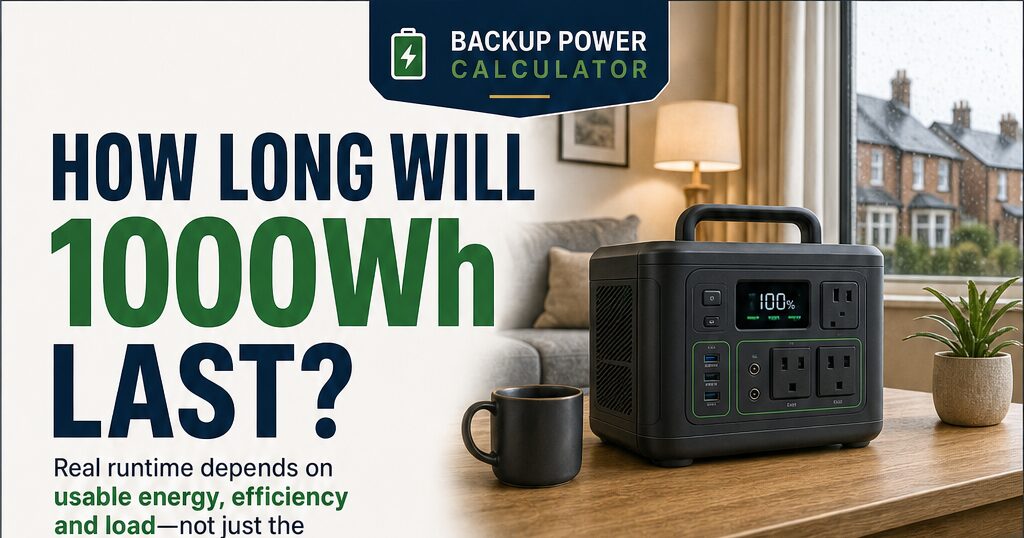

How long will a 1000Wh power station last? The quick estimate is:
Runtime in hours = usable battery energy in watt-hours × efficiency ÷ load in watts
That means a 100W appliance might run for roughly 8.5 hours if the power station provides 1,000Wh nominally, 85% of that energy is usable and the conversion system is treated as already accounted for. A different unit, load or operating mode could produce a noticeably different result.
The 1,000Wh figure describes stored energy, not a guaranteed runtime. To estimate a useful answer, you need the appliance’s actual running wattage, the power station’s usable capacity, conversion losses and, for intermittent appliances, the average duty cycle.
What does 1000Wh mean?
A watt-hour (Wh) is a measure of energy. A 1,000Wh power station theoretically stores enough energy to supply:
- 1,000W for one hour;
- 500W for two hours; or
- 100W for ten hours.
Those are idealised figures. They do not allow for inverter losses, battery-management limits, the station’s own display and control electronics, or an automatic low-load shutdown. The energy available at the output socket is therefore usually less than the headline battery capacity.
Also check whether the advertised 1,000Wh is a nominal battery rating or a stated usable/output capacity. These are not necessarily the same thing. The manufacturer’s specification should say which figure it uses and whether its runtime examples include the station’s own consumption.
How long will a 1000Wh power station last at different loads?
The following examples use a simple illustration: 850Wh reaches the appliance after allowing for usable capacity and conversion losses. They are not universal results for every 1,000Wh unit.
| Average load | Illustrative runtime | Typical use |
|---|---|---|
| 10W | About 85 hours | Small electronics or lighting |
| 50W | About 17 hours | Router, monitor or small fan |
| 100W | About 8.5 hours | Laptop, television or modest appliance |
| 200W | About 4.25 hours | Several small devices together |
| 500W | About 1.7 hours | A larger continuous load |
| 1,000W | About 51 minutes | A high continuous load |
At very low loads, the result can be worse than the table suggests because the power station itself consumes some energy. Some models may also switch off if the connected load is below their minimum threshold. At high loads, the unit may impose an output limit, become less efficient or stop when its battery-management system reaches a protection threshold.
The formula for calculating 1000Wh runtime
For a continuous load, use:
Runtime = usable energy × conversion efficiency ÷ appliance watts
If you only have the nominal 1,000Wh capacity, you can combine the allowances into one practical estimate:
Runtime = 1,000Wh × usable-capacity factor × efficiency ÷ load in watts
For example, suppose an appliance draws 120W, the unit makes 90% of its nominal capacity available and the AC conversion efficiency is 85%:
1,000 × 0.90 × 0.85 ÷ 120 = 6.375 hours
That is about six hours and 23 minutes in this worked example. It should be read as an estimate, not a promise. The power station’s specification may use different efficiency assumptions, and the appliance may not draw exactly 120W throughout its operation.
For a more dependable estimate, use the manufacturer’s stated usable output energy if it is available. If the appliance is connected through USB or a DC output rather than the AC inverter, use the relevant output path’s figures where provided. Avoid applying an AC inverter loss to a DC load unless the power is actually passing through that inverter.
Why the appliance’s wattage matters
Watts describe how quickly an appliance uses energy. Watt-hours describe how much energy it uses over time. A 100W appliance running for five hours uses roughly 500Wh before allowing for losses.
The number printed on an appliance may not represent its real, continuous demand:
- A laptop charger rated at 100W does not necessarily draw 100W continuously; the computer’s demand changes with workload and charging state.
- A television can vary its consumption with screen brightness, sound level and picture mode.
- A fridge or freezer cycles on and off, so its average consumption is lower than its compressor’s running demand, but the start-up requirement can be much higher.
- A kettle, heater or other resistive appliance may draw close to its rated power while switched on, making it a heavy load for a 1,000Wh station.
Check the appliance data plate, charger label or manufacturer specification. If the device reports energy use in kilowatt-hours, convert it to watt-hours by multiplying by 1,000. A smart plug with power monitoring can also help identify changing loads, but its reading is an estimate and should not replace the power station’s output limits.
Running watts and starting surge are different
Motors and compressors can demand a short burst of power when they start. This is commonly called starting, surge or peak wattage. The normal running wattage may fit within a power station’s continuous output rating while the start-up demand exceeds its surge rating.
If that happens, the station may shut down or fail to start the appliance. This is not primarily a runtime problem: a brief surge may use relatively little energy, but it is still a compatibility problem. Check both the power station’s continuous and peak output ratings and the appliance’s starting requirement where the manufacturer provides it.
Do not assume that a 1,000Wh battery has a 1,000W AC output. Capacity and output power are separate specifications. A unit may store 1,000Wh but be unable to run a particular appliance because its inverter is rated below the appliance’s running or starting demand.
AC appliances, USB devices and conversion losses
Power supplied through a 230V AC socket normally passes through an inverter. That conversion consumes some of the stored energy. USB and DC outputs may use a different conversion stage, so their efficiency can differ.
The power station’s own electronics also consume energy while it is switched on. The effect is especially noticeable with small loads. For example, running one low-power device from an AC socket may be less efficient than using an appropriate direct USB or DC output, if the device and power station support that connection safely.
Use the correct cable and output for the appliance. Do not exceed the output voltage, current or connector limits, and do not treat a USB rating as proof that an appliance is compatible without checking its requirements.
Intermittent loads need an average, not just a rating
For an appliance that cycles, estimate its average load over the period you care about:
Average load = operating wattage × proportion of time operating
As an illustration, a 200W appliance that runs for half of each hour has an average load of about 100W. Using the earlier 850Wh example, that would suggest around 8.5 hours, before considering start-up behaviour, temperature, inverter overhead and changing cycle times.
Fridges, freezers, pumps and heating or cooling equipment can be particularly difficult to predict. Their cycle length depends on the model, room temperature, contents and settings. Use a measured average where possible, and leave headroom rather than planning around the most optimistic figure.
How to improve the runtime estimate
Before relying on a calculation during an outage, collect these figures:
- Find the power station’s usable energy, continuous AC output and surge output in its specification.
- Record the appliance’s running wattage and, for motor-driven equipment, its starting requirement.
- Decide whether the load is continuous or cycling. Use average watts for a cycling appliance.
- Allow for the power station’s own consumption and conversion losses. If the manufacturer gives an efficiency or runtime test method, use that information rather than borrowing a generic percentage.
- Keep a margin below the station’s maximum output and plan for less runtime than the theoretical result.
For several devices, add their simultaneous average wattages. Include devices that may start unexpectedly, such as a fridge compressor. Then compare the combined load with both the continuous and surge ratings.
The UK Backup Power Calculator can help organise appliance wattages, runtime and surge requirements in one planning step. Enter measured or manufacturer-provided figures rather than assuming that every device uses the number printed on its charger.
What can a 1000Wh power station run?
A 1,000Wh unit is generally more suited to modest electronics, communications equipment, lighting and selected small appliances than to long-running high-power heating loads. The practical answer depends on the station’s output rating as well as its capacity.
For example, several low-power devices may run for many hours if their combined demand remains modest. A single 1,000W appliance could use most of the available energy in about an hour under favourable assumptions, and it may still be unsuitable if its start-up or continuous demand exceeds the inverter rating.
Do not use a general runtime calculation as a recommendation for life-support or other critical medical equipment. Follow the device manufacturer’s backup guidance and seek advice from the relevant clinical and electrical professionals.
If you are considering a combustion generator as an alternative, it must be operated outdoors and well away from buildings, doors, windows and other openings. Never run one in a home, garage, cellar or similarly enclosed space because of carbon-monoxide risk. The Health and Safety Executive’s generator guidance covers the basic safety considerations.
Frequently Asked Questions
How long will a 1000Wh power station last with a 100W load?
The ideal calculation is 10 hours. A practical estimate is lower after usable-capacity limits, inverter losses and the station’s own consumption. If 850Wh reaches the output, the estimate is about 8.5 hours, but check the particular model’s specification.
Can a 1000Wh power station run a fridge?
It may, but capacity alone does not answer the question. Check the fridge’s average energy use, compressor starting demand and the power station’s continuous and surge ratings. Temperature and cycling behaviour also affect runtime.
Does a 1000Wh power station provide 1000W for one hour?
Not necessarily. That is an ideal energy comparison, and the station may have less usable energy at its outputs. It must also have an inverter rated to supply 1,000W continuously, with enough surge capacity if the appliance needs it.
How can I get the longest runtime from a 1000Wh power station?
Use the lowest practical load, switch off devices that are not needed, use a suitable USB or DC output where appropriate, and avoid running high-power appliances. Keep the station within the operating conditions stated by its manufacturer and do not plan around the theoretical maximum.
For your own estimate, start with the appliance’s measured watts, check the power station’s usable energy and output limits, then run the figures through the UK Backup Power Calculator before choosing what to connect.